The throne is not being pursued cheaply
In Game of Thrones—one of the most talked-about shows of the last decade—the Iron Throne was never won cheaply. It required blood and fire before feuding kings would bend the knee. Oracle is learning the same lesson the hard way: without blood and fire, there is no glory in conquering the AI throne.
If you are bearish on the AI theme, it may be music to your ears that most Big Tech companies have fallen considerably over the past few months, largely because of what the market perceives as a capex explosion. I do not know whether the market is overreacting, but it is fair to say that investors are not liking the perceived return-on-investment picture surrounding AI spending. Amid this downturn, few companies have stood out to me more than Oracle.
Originally incorporated in 1977, Oracle has been a mainstay of the American technology industry for decades and has been steered by the seemingly reverse-aging billionaire Larry Ellison. The recent turmoil in the stock price has left many wondering whether Larry is steering the ship in the right direction. In this article, I will examine the company overview, management’s rationale behind the spending and the inherent risks to its AI strategy.
Cloud and software still carry the business
Oracle operates through three business segments: 1) cloud and software, 2) hardware, and 3) services. In the recent quarterly report, the company reported solid growth on all the metrics as seen below. The cloud and software segment carried the bulk of the weight accounting for 87.2% of revenue, while hardware and services contributed 4.8% and 7.9% to the top-line figure, respectively.
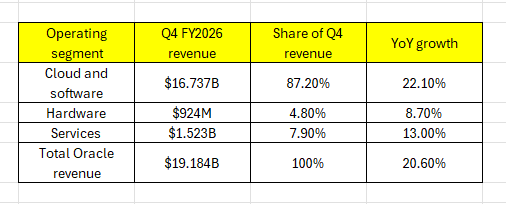
The growth rate YoY was also impressive with cloud and software services growing at 22.1% while the slowest growth was seen in the hardware segment at 8.7%. The GAAP net income rose by 37% to $17.087 billion compared to $12.44 billion in FY2025, resulting in a 34.3% increase in diluted EPS to $5.83. At approximately $126 per share, Oracle has a market capitalization of $367 billion. The stock is trading at approximately 21.7 times FY2026 GAAP diluted EPS of 5.83 and about 15.7 times FY2027 non-GAAP EPS guidance. It is fair to say, based on the forward multiples, that the stock does seem inexpensive relative to the strength shown in its recent financial report. By financial metrics, the company had a good year in a challenging macro environment. So then, what is the reason the market has punished the stock by whiplashing it for close to 44% off its YTD high of $225.78? The answer lies in the management’s strategy over AI capital expenditure.
Capex is where the thesis gets dangerous
In the winner-takes-all race for AI dominance, Oracle and other Big Tech giants (Amazon, Meta, Microsoft and Google) are spending a stupendous amount of money. The rationale behind the capital outlay is simple: whoever builds the most compute capacity first will lock in long-term contracts with compute-hungry companies and will subsequently dictate pricing standards within the industry. In other words, compute infrastructure is the gold rush of this decade.
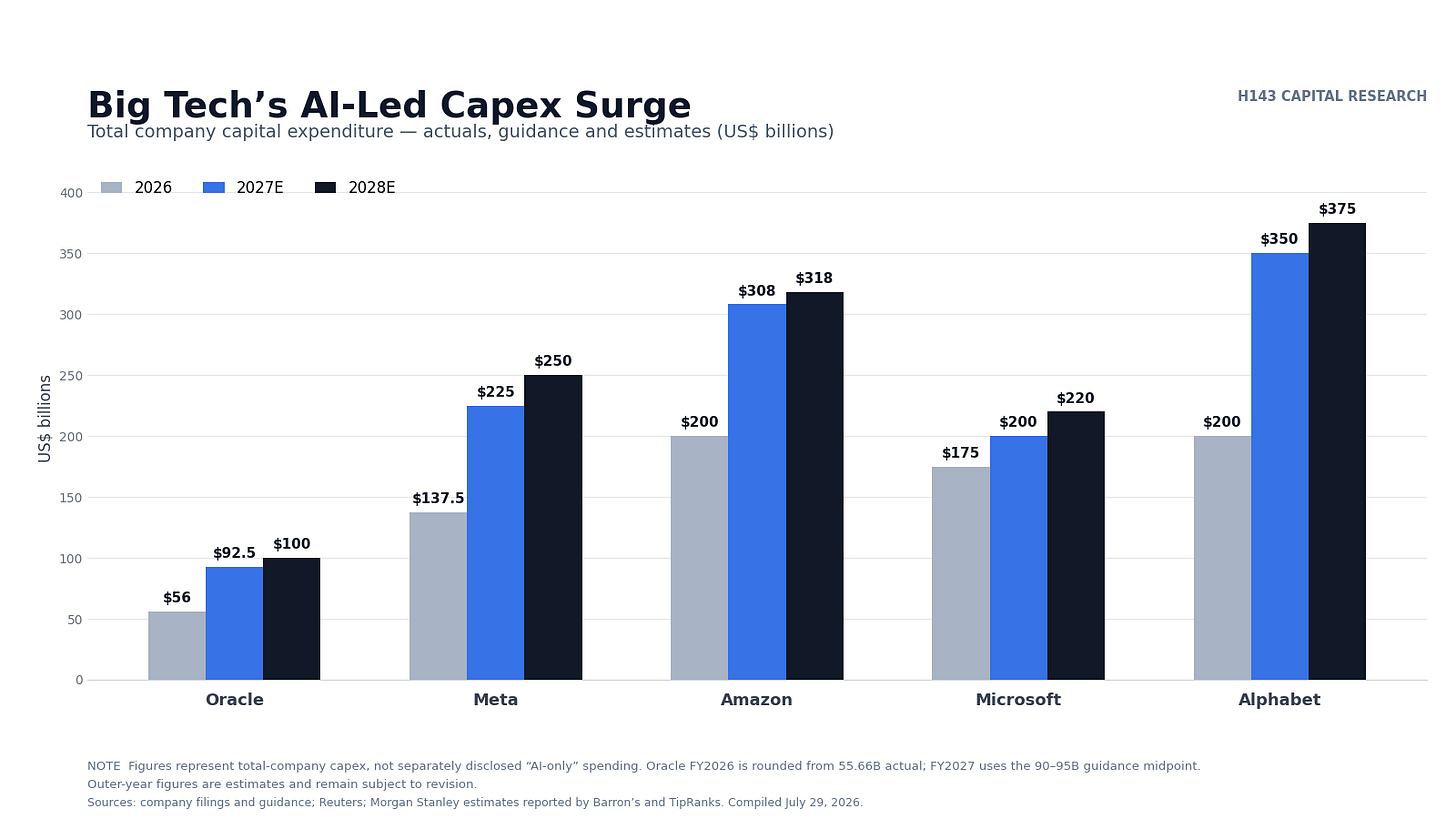
In the FY2026, Oracle originally forecasted to spend around $50 billion in total capex however, as per its latest reporting, it ended up spending close to $56 billion. The additional 12% increase in the capex was blamed on elevated spending on data-center construction and delivery capacity against the record backlog (I will come to this later). For the current fiscal year, it is projected to spend $92.5 billion on capex while projecting another 8.1% increase for FY2028. Even if we do back of napkin math, the numbers don’t add up. If the company keeps its operating cash flow margin at approximately 47.5% then based on the revenue estimates, I arrive at substantially negative cash flow.
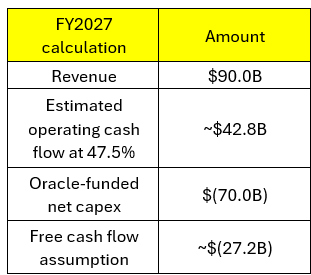
The outstanding indebtedness is reportedly at $129.5 billion with $31.9 billion of cash, cash equivalents, and marketable securities. The total net debt stands at approximately $97.6 billion, with $4.6 billion alone going into interest expense for FY2026. With negative free cash flow, it is easy to understand why the market has punished the stock. Not only has the stock been almost cut in half, but the bond vigilantes have also joined the party by demanding higher yields on long-duration bonds causing a downgrade of its bonds to a level above junk status. In the latest downgrade to BBB-, the S&P mentioned that “Oracle’s expanding AI-infrastructure business was weakening its credit profile and that it had underestimated the required investment” (Wall Street Journal, July 9). Moreover, the company’s credit-default swaps (insurance against Oracle’s debt) are trading at nearly 200 basis points versus approximately 53 basis points for the broader investment-grade index.
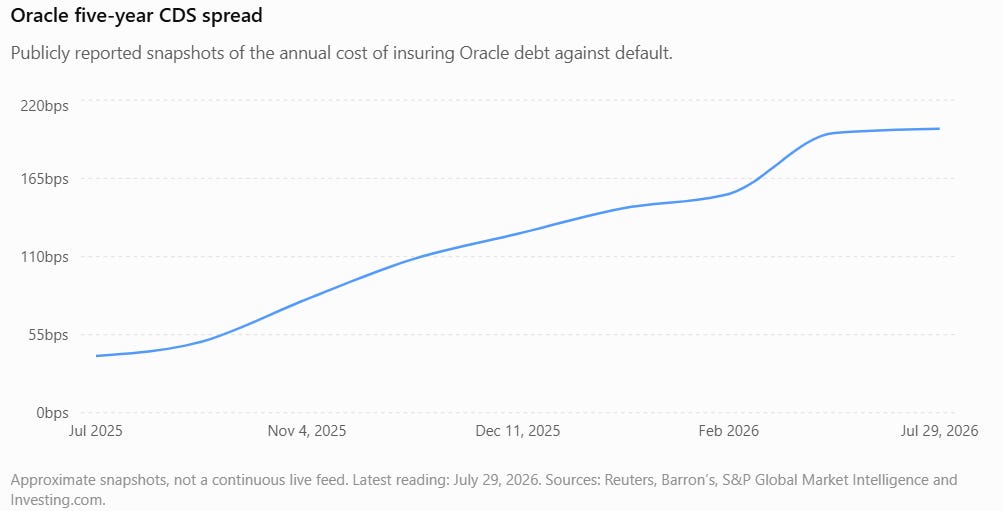
Even the famous investor Michael Burry has publicly disclosed (via his Substack) a short position on Oracle with the primary reasoning being amount of money being spent by the company in the AI arena.
All of this is telling the company to slow down the capital expenditure until a return on invested capital is seen. However, the company has reassured the investors by outlining the record backlog it has for its services. In the latest earnings call, management specified that the company ended fiscal year 2026 with a record $638 billion in RPOs, which is up 363% from FY2025. Oracle has not disclosed a customer-by-customer breakdown of its backlog. However, reports suggested that OpenAI is its largest customer, accounting for close to 50% of the backlog through its computing needs. It is fair to say that if OpenAI cannot monetize its business model, Oracle could be left with a significant debt burden and no short-term return on its capital investments. Separately from Oracle’s own capital expenditure plans, Larry Ellison has made another financial commitment to support his son, David Ellison, in purchasing Warner Bros. Discovery at a price of $110 billion. Larry Ellison’s family trust will provide $46.7 billion in equity financing while the rest is a mix of financing from RedBird Capital Partners and other debt obligations. Even though Oracle is not responsible for this acquisition, much of the wealth of the trust is concentrated in Oracle stock. It is fair to say that any selling by the trust will cause further pressure on the stock and make investors even more nervous about the stability of the company.
A stabilizing source of demand
In all the doom and gloom about its future, there is some hope for the company in the name of Donald Trump. President Trump is a supporter of Larry Ellison and his son, both of whom are mainstays in the Trump orbit. Recently, the Department of War signed a five-year agreement with Oracle valued at $7 billion to provide enterprise-wide software products to its military, Coast Guard, and intelligence community. Also, as seen in the case of Intel, the US government could see Oracle and its infrastructure as a critical national security need vis-à-vis China and could potentially take equity stakes. Although there is no suggestion of this currently, it is fair to say nothing can be ruled out with the current administration.
The market has already yelled Dracarys
Oracle has seen many bull and bear cycles, showing resilience and steadfastness during the dot-com bust era as well as the 2008 financial crisis. The company is integrated deeply within the technology industry via its array of software as well as hardware offerings. The future growth of AI may be debatable, but the current revenue rate and top- and bottom-line figures are impressive. However, even amidst all this, as an investor I am left with the feeling that the company is overleveraging its future based on a handful of customers. Any material change to even one or two of its customers can rapidly deteriorate its financial situation and cause a massive loss in value. The market has already yelled “Dracarys.” The question isn’t whether Oracle claims the Iron Throne – it’s whether it survives the fire it lit to get there.