
A Canadian space platform after a sharp reset
“Exploration is in our nature. We began as wanderers, and we are wanderers still,” Carl Sagan wrote in Cosmos. Few public companies fit that idea as naturally as MDA Space, a Canadian company that has spent more than five decades helping humanity work beyond Earth.
MDA Space Ltd. traces its roots to MacDonald, Dettwiler and Associates, founded in Vancouver in 1969. Today, the company is headquartered in Brampton, Ontario, and trades on both the Toronto Stock Exchange and the New York Stock Exchange under the ticker MDA. Best known historically for the Canadarm, MDA has developed into a broader space and defence platform with capabilities spanning satellites, robotics and Earth-observation intelligence.
MDA discloses revenue across three business areas: Satellite Systems, Robotics & Space Operations and Geointelligence. The stock has been volatile in 2026, rising roughly 57% year to date before giving back about 17% over the past month. Part of that swing appears connected to broader space-sector sentiment following SpaceX’s June IPO and sharp post-listing decline. This article examines MDA’s valuation, recent acquisitions, Q2 setup, technical picture and the risks that could shape future returns.
Premium multiple, faster growth and a backlog test
(All figures are in Canadian dollars unless otherwise indicated.)
MDA closed July 24 at C$41.72, giving it a market capitalization of approximately C$6.76 billion based on roughly 161.9 million common shares outstanding after the July equity offering. Before the transaction, the company had approximately 138.9 million shares outstanding. The 23 million shares issued on July 14 increased the basic share count by about 16.6%.
The distinction is important. The current market capitalization already reflects the new shares, so adding another 23 million shares would double-count the offering. The dilution still matters, however, because trailing EPS was calculated using a lower weighted-average share count for periods before the July issuance.
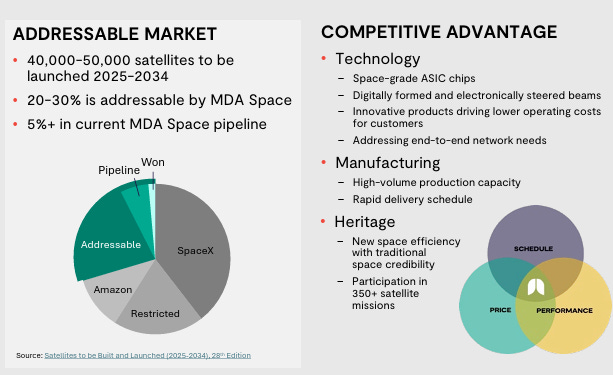
At the July 24 close, MDA traded at approximately 57 times trailing reported earnings, around 32 times forward earnings and roughly 17 times forward EV/EBITDA, depending on the forecast period and data source. Established aerospace and defence companies such as L3Harris, RTX and Lockheed Martin have generally traded closer to 15 times EV/EBITDA and 20 times forward earnings. MDA therefore remains a premium-priced company even after its recent correction.
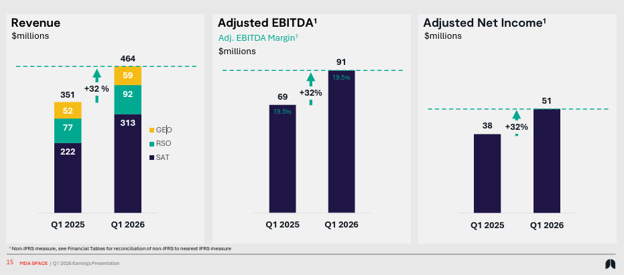
That premium rests on MDA’s faster expected growth and its exposure to satellite systems and space robotics. In Q1 2026, revenue reached C$464.1 million and adjusted EBITDA was C$90.6 million, producing a 19.5% adjusted EBITDA margin. Satellite Systems contributed C$313.1 million, or 67.5% of revenue. Robotics & Space Operations generated C$91.6 million, while Geointelligence contributed C$59.4 million.
Satellite Systems is clearly MDA’s bread and butter. It produces most of the company’s revenue and has been the primary growth engine. Management is now adding another lever through the planned acquisition of Blue Canyon Technologies, discussed below.
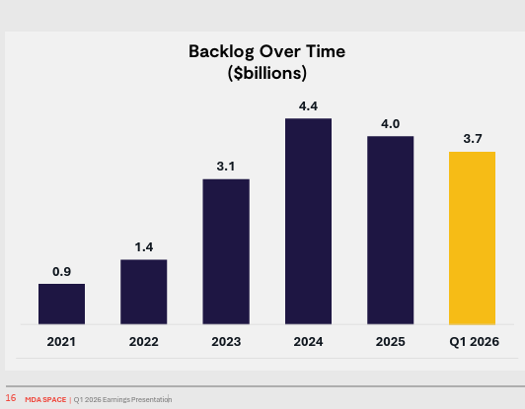
Backlog declined to C$3.69 billion in Q1 2026 from C$4.01 billion in Q4 2025, an 8% sequential drop. Revenue conversion continued to outpace new order bookings during the quarter.
The book-to-bill ratio remained weak, measuring approximately 0.24x in Q4 2025 and 0.31x in Q1 2026. Management has not issued specific Q2 book-to-bill guidance, but the C$688 million Canadian Space Agency contract will enter backlog during the quarter. Against expected Q2 revenue near C$446 million, that award alone could push the ratio above 1.0x and toward 1.5x. That is my estimate, not company guidance.
MDA generated C$165.3 million of free cash flow in fiscal 2025 but reported negative free cash flow of C$27.6 million in Q1 2026. Management expects full-year 2026 free cash flow to be neutral to negative because of working-capital requirements and C$225 million-C$275 million of capital spending. The outlays include expansion of the Montreal-area production facility and investment in space-grade chip development. A simple forward P/E-to-growth calculation can produce a PEG ratio near 1.0x, but I would not lean too heavily on it because much of the projected earnings growth depends on acquisitions. On an absolute basis, the stock is still not cheap.
Blue Canyon and CLS could change the scale of the company
The industry backdrop remains favourable. Space Foundation estimates that the global space economy reached approximately US$686 billion in 2025, up 12% from US$613 billion in 2024. The World Economic Forum and McKinsey estimate that the market could reach US$1.8 trillion by 2035. The opportunity is large, but so is the competition for government programs, commercial constellations and data-service customers.
One of MDA’s strongest advantages is its position as a long-standing Canadian space contractor. Its Canadarm heritage and relationships with federal agencies give it credibility in sovereign space, defence and Earth-observation programs. That does not guarantee future awards, but Canada’s renewed focus on national security and domestic capability should leave MDA well positioned. Management is also trying to extend that position internationally through two transformative transactions: a definitive agreement to acquire U.S.-based Blue Canyon Technologies and a firm offer for a majority stake in France-based CLS. Blue Canyon builds small-satellite buses, complete spacecraft, components and mission systems. CLS converts satellite and sensor data into monitoring, forecasting and decision-support services. Blue Canyon is expected to close by the end of 2026, while CLS is targeted for late 2026 or early 2027.
MDA agreed to acquire Blue Canyon from RTX for US$620 million in cash. To finance a substantial portion of the purchase, MDA priced C$600 million of 6.50% senior unsecured notes due in 2033. The balance is expected to come from existing liquidity and available borrowing capacity. The note offering is expected to close on August 5, subject to customary conditions.
Blue Canyon gives MDA a stronger industrial and commercial foothold in the United States, particularly in government and national-security space. MDA estimates that the business will generate approximately US$160 million, or C$225 million, of revenue in 2026. That is equivalent to about 20% of MDA’s 2025 Satellite Systems revenue. The acquisition is also expected to add US$3.5 billion to MDA’s opportunity pipeline, although pipeline should not be confused with contracted backlog.
In practical terms, Blue Canyon deepens MDA’s upstream capabilities in spacecraft manufacturing and mission systems. CLS addresses the other end of the value chain by strengthening the downstream Geointelligence business.
MDA plans to acquire approximately 70% of CLS, while the French space agency, CNES, would retain approximately 30%. The transaction remains subject to mandatory employee consultation, regulatory approvals and other closing conditions. CLS would expand MDA’s reach in Europe and other international markets through more than 14,000 customers across approximately 150 countries.
CLS is expected to generate €286 million of revenue in 2026, representing a 22% compound annual growth rate since 2023. Retention among its top 100 customers is approximately 99%, while its top 20 customers have stayed with the company for an average of 18 years. MDA will pay approximately €567 million in cash for the 70% stake. It may also need to fund roughly €198 million to retire CLS debt if that borrowing cannot be refinanced at closing.
MDA intends to fund part of the CLS transaction with its July equity offering, which issued 23 million shares at US$35.60 and raised approximately US$819 million in gross proceeds. MDA would consolidate 100% of CLS revenue and adjusted EBITDA, while CNES’s 30% stake would be reported as a non-controlling interest. Strategically, CLS moves MDA further into recurring satellite-data processing, forecasting and analytics services.
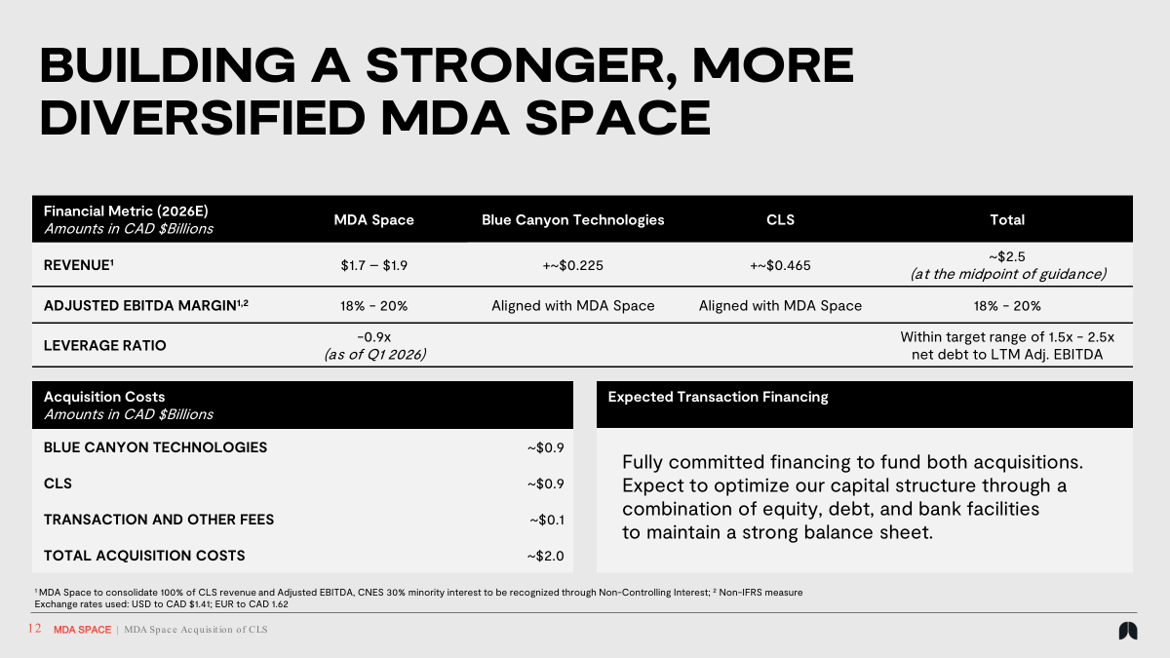
Together, the acquisitions could materially increase MDA’s scale. Combining roughly C$1.8 billion of standalone MDA revenue with C$225 million from Blue Canyon and C$465 million from CLS produces an illustrative annual revenue base near C$2.5 billion. This is useful for understanding the potential size of the combined company, but it is not formal consolidated 2026 guidance. Closing dates, purchase accounting and the timing of contributions will determine the reported results.
Backlog, capex and integration roadmap matter most
MDA’s 2026 outlook calls for C$1.7 billion-C$1.9 billion of revenue, C$320 million-C$370 million of adjusted EBITDA and an adjusted EBITDA margin of 18%-20%. Analyst consensus is near C$1.83 billion of revenue and C$351 million of adjusted EBITDA, almost exactly at the midpoint of management’s ranges.
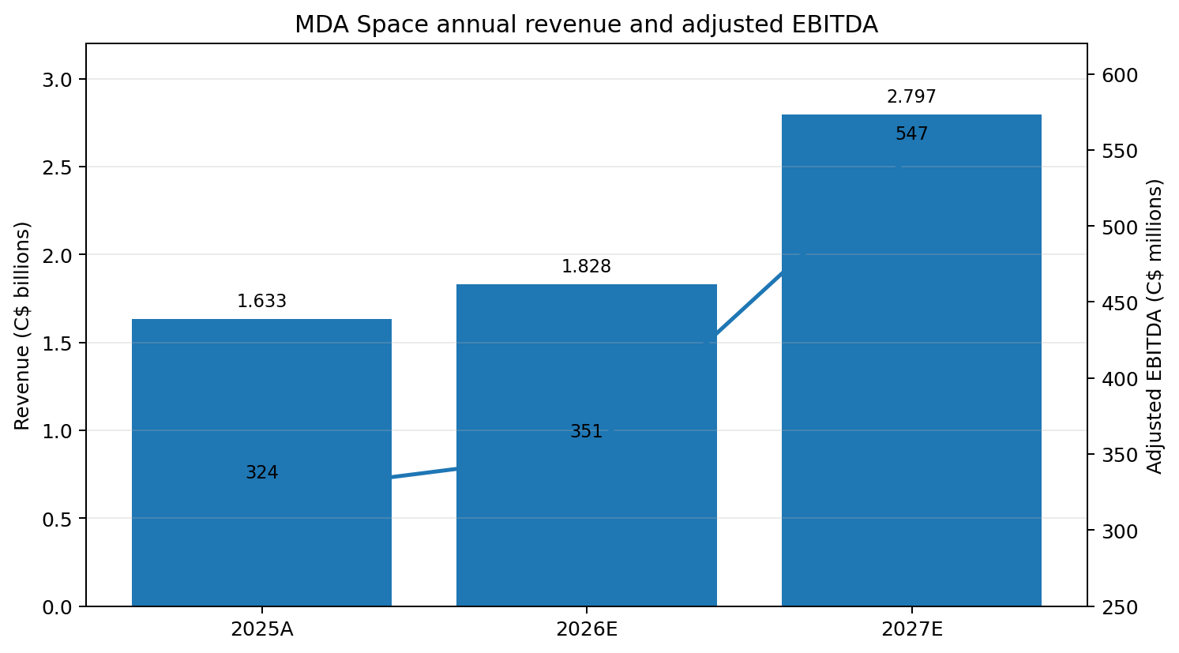
The 2027 expectations are more demanding. Consensus points to approximately C$2.80 billion of revenue and C$547 million of adjusted EBITDA, implying growth of roughly 53% and 56%, respectively. MDA has not issued formal 2027 guidance. These estimates appear to assume that Blue Canyon and CLS close and contribute for much of the year, so investors should view them as acquisition-dependent rather than purely organic forecasts.
For Q2 2026, consensus is approximately C$446 million of revenue and C$85 million of adjusted EBITDA. MDA will report before the market opens on August 7. A modest beat would help, but the more important questions are whether backlog returns to growth, capital spending stays on plan and management provides a clearer integration and pro forma leverage roadmap.
The chart has not confirmed the correction is over
The chart has weakened alongside the recent sell-off. After reaching a 52-week high of approximately C$67.90, MDA entered a steep correction and moved into the low-C$40 range. At the July 24 close of C$41.72, the shares were roughly 39% below their high.
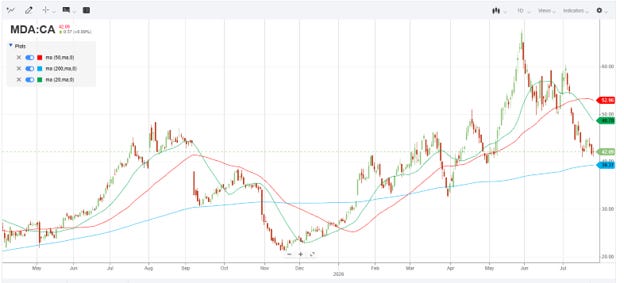
The stock is below its 20-day moving average near C$49.15 and its 50-day moving average near C$53.36, leaving sellers in control of the short- and intermediate-term trends. The first support zone is around C$39-C$42. A decisive close below C$39 could open the door to C$35-C$38, which would represent a deeper retracement and potentially a more attractive valuation area for long-term investors.
The first resistance zone is approximately C$44-C$46. A move above C$45 would be an early sign that selling pressure is easing. The more important test is C$50-C$55, where the stock would encounter its moving averages and overhead supply from investors who bought at higher prices.
MDA’s long-term chart is not yet broken, but the short- and intermediate-term structures remain bearish. The C$39-C$42 range is a reasonable area to consider a small starter position only if the shares begin to stabilize. The Q2 report will likely determine whether the stock forms a base or continues lower; the chart does not yet confirm that the correction is over.
A profitable space company still carries space-company risk
Space is hard, and running a profitable space company is harder still. MDA has raised US$819 million of equity and priced C$600 million of senior unsecured notes to help fund two large acquisitions. Integrating both businesses within a similar time frame could pressure margins, increase costs and stretch management attention.
Backlog has declined because bookings have not kept pace with revenue conversion. The C$688 million CSA contract should improve Q2, but investors need to see whether MDA can sustain stronger bookings beyond one large award. Customer and program concentration adds risk because delays, financing problems or scope changes on a major satellite program can shift revenue across several quarters.
MDA recognizes revenue under a mix of fixed-price contracts and cost-plus arrangements with ceilings. Cost overruns or unexpected delays on fixed-price work can pressure margins. Large programs also carry technical, supply-chain, launch and geopolitical risks, even when the underlying customer is financially secure.
MDA also competes with larger companies, including L3Harris, Thales, Maxar and Northrop Grumman. Their scale, balance sheets and government relationships make contract competitions demanding. Blue Canyon and CLS must still clear regulatory and closing conditions; a delayed or failed closing would alter the growth and valuation assumptions currently embedded in consensus forecasts.
Finally, space stocks often trade as a group. Negative headlines involving SpaceX, Rocket Lab or another high-profile operator can weigh on the entire sector even when MDA’s operations are unaffected. Changes to CUSMA, cross-border trade rules or the Canadian dollar could also influence input costs, reported results and the integration of U.S. operations.
A cautious Buy, not a blank cheque
MDA is a profitable space company trading at a meaningful premium that is partly justified by its growth profile. Blue Canyon and CLS would give the company a broader package across the upstream and downstream layers of the space economy. Management has built a credible record of scaling revenue, expanding internationally and converting a large backlog despite the supply-chain challenges common in this industry.
At roughly C$42, I view MDA as suitable for a small starter position for long-term growth investors and rate the shares a cautious Buy. I would wait for the Q2 update before adding more, particularly to assess backlog replenishment, capital spending, pro forma leverage and the likely cost of integrating two acquisitions.
As Carl Sagan once said, “The sky calls to us. If we do not destroy ourselves, we will one day venture to the stars.” I feel much the same way about MDA. If the company integrates its acquisitions, controls costs and replenishes its backlog, I believe the shares can travel a good deal closer to the stars than where they trade today.