Choosing plata while the market reaches for plomo
In Narcos—one of my favorite shows of all time—the cartel headed by Pablo Escobar famously reduces the entire narrative to three words: plata o plomo—silver or lead. Now, I am not encouraging any violence here, but the market sometimes chooses plomo for good companies based on misconceptions, and Autodesk is one of them.
Autodesk is an engineering software company that operates under a SaaS model, providing specialized cloud and desktop tools across architecture, engineering and construction, manufacturing and product design, and media and entertainment. It offers well-known products such as AutoCAD, Revit, Fusion, and Civil 3D for day-to-day engineering work. One could say that Autodesk, along with a handful of other companies, forms part of the backbone of the physical infrastructure ecosystem in today’s world.
The market punished the deal
Recently, Autodesk made the strategic move to acquire MaintainX for $3.6 billion. The purchase is one of the largest acquisitions the company has made in recent years, eclipsing the $1 billion it paid for Innovyze in 2021. The main rationale behind the acquisition is that it could give Autodesk an opportunity to bridge the gap between design and engineering implementation and daily maintenance and operations.
Even though this acquisition would make the company more vertically integrated across its product offerings, the market reacted in its usual manner—punishing the stock with a drop of nearly 7% and pushing it to a year-to-date low of $187.50. The market’s concern appears to be that the company plans to pay approximately $1.6 billion in cash, with the remainder funded through new debt financing, including a loan facility and an increase in its revolving credit facility.
Currently, the stock is trading at $206.50, with a market capitalization of approximately $43.46 billion on a fully diluted share basis. The company is trading at a fiscal 2027 forward non-GAAP P/E of approximately 16.4 times, representing a significant discount to its more typical forward P/E range of 28 to 32 times.
Autodesk is trading near one of its lowest forward valuation multiples in recent years, raising an important question: has the investment thesis broken?
My answer is no.
The financials do not look broken
If we look purely at the financials—and I will come to everyone’s favorite word, “AI,” later—the company is projecting revenue of $8.155 billion to $8.215 billion for the year, implying a growth rate of approximately 11% to 12% relative to fiscal 2026 revenue. For the second quarter of fiscal 2027, the company has guided for revenue of $2.005 billion to $2.015 billion, with a non-GAAP operating margin of approximately 39% and an implied full-year free-cash-flow margin in the range of approximately 33.5% to 34.1%.
The company has modelled operating cash flow of approximately $2.795 billion to $2.87 billion, with capital expenditures of approximately $70 million for the year. Stock-based compensation continues to remain within what I consider a respectable range, although investors should continue monitoring its effect on dilution and the company’s share count.
If we look purely at the numbers, Autodesk’s business is not breaking down to the extent implied by Mr. Market. Autodesk’s latest quarter produced revenue of $1.934 billion, operating cash flow of $893 million, and capital expenditures of $17 million.
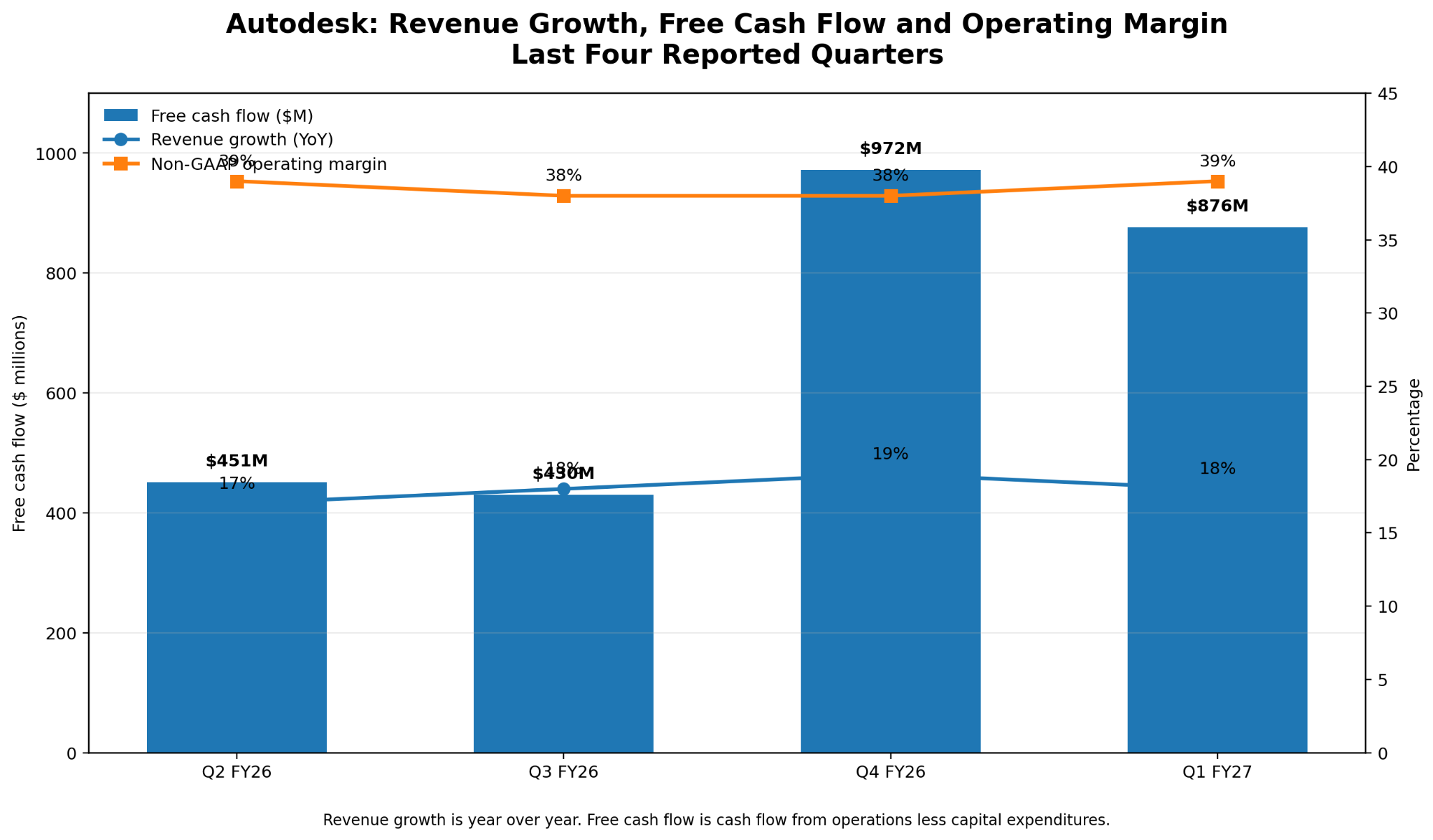
The graph shows that Autodesk’s underlying performance has remained consistent. Revenue growth has stayed within a narrow range, operating margins have remained strong, and free cash flow has remained healthy despite normal quarterly seasonality.
A sticky platform behind physical infrastructure
If we examine the competitive moat, we can conclude that Autodesk has one of the stickiest software platforms available. In today’s world, where AI is powering everything from my toaster to Zuckerberg’s Meta glasses, Autodesk—with its array of engineering design tools, including AutoCAD, Fusion, and Revit—is an essential cog in bringing physical infrastructure to fruition.
Moreover, university students and professional engineers use these software products daily. It is very difficult to switch to a new product, especially considering that AutoCAD has been around for decades.
The company does have competitors, namely Dassault Systèmes for CAD and CAM engineering design, as well as Nemetschek Group and Bentley Systems for civil engineering and infrastructure design. However, it is fair to say that the scale of Autodesk and Dassault Systèmes overshadows many of the remaining small and mid-sized market participants.
As someone who has worked in the engineering world, I would say that the market is tilted toward Dassault Systèmes on the high-end aerospace design side, whereas Autodesk is stronger in civil and general mechanical engineering design work.
What could change the thesis
As with any investment, no matter how large the moat is or how sticky the platform may be, there are always variables that could change the investment thesis.
For Autodesk, the main risks include potential headwinds and difficulties associated with integrating the MaintainX acquisition. The company is paying close to 26 to 27 times MaintainX’s annual recurring revenue, as well as a price reportedly equivalent to approximately 35 to 50 times book value.
Another risk to consider is that if geopolitical tensions remain elevated and inflation returns, the Federal Reserve may have to raise interest rates, which could negatively affect the company.
Additionally, if the AI theme loses momentum, many large infrastructure projects could be delayed or cancelled. This could affect Autodesk through lower demand, slower customer expansion, and weaker renewal rates among current and future customers.
Strong business, discounted multiple
Autodesk offers an attractive valuation at approximately 16 times forward earnings, supported by a durable moat and double-digit growth. It provides services that are critical to physical infrastructure, and the recent MaintainX acquisition creates a unique opportunity for a future growth cycle.
Management has a solid track record of progressing the business and creating new revenue streams. With its current product portfolio and range of services, I believe Autodesk is uniquely positioned to create significant value for shareholders.
As Pablo Escobar said, plata o plomo. In this case, the market chose plomo, while I am choosing the plata—in the form of Autodesk shares.